“What did you learn in English today?” is a surprisingly hard question to answer on the walk home.
Imagine being eight. You spent the last ten minutes trying to guess an animal from two clues. You remember that somebody guessed a squid. You remember arguing about how many arms it had. Now you have to decide what all of that was a lesson about. “Animals,” you say. Your parent says, “Oh, nice.” There goes a perfectly good squid argument.
I’d like to give the parent a way into the game. One sentence at the bottom of the lesson recap can do it.
Let the child know something you don’t
Here’s the line I’d send after that animal lesson.
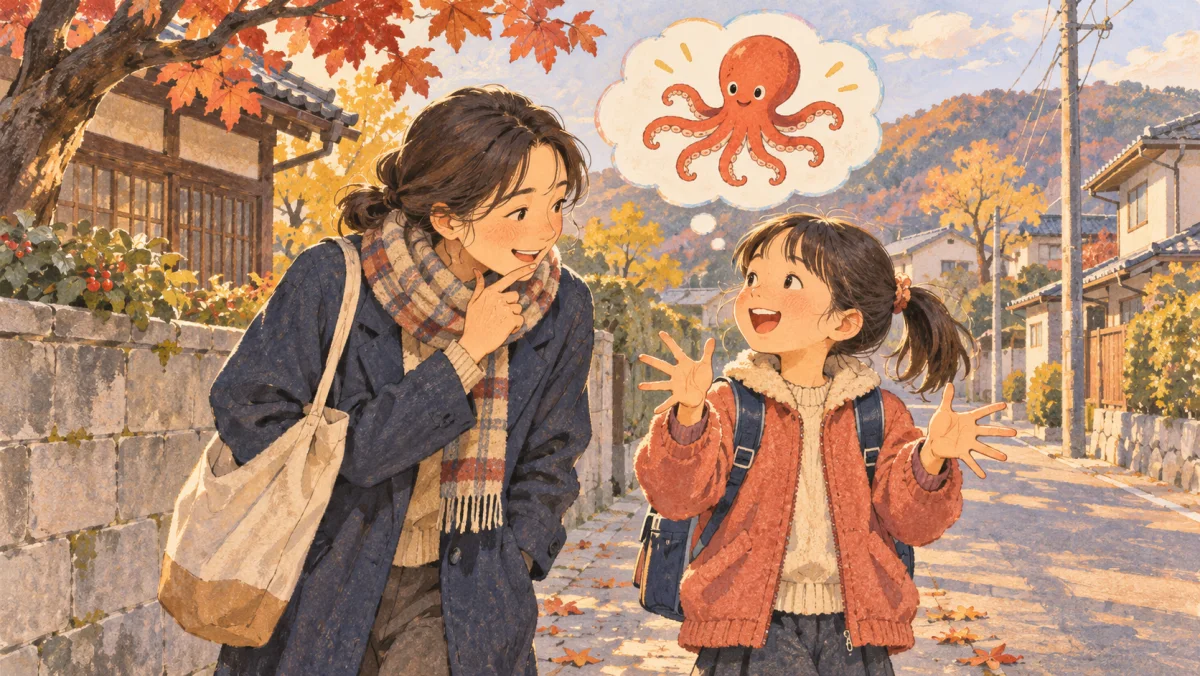
On the way home, ask your child to pick a secret animal and give you two clues in English. See if you can guess it.
“It lives in the sea. It has eight arms.” Now the parent has a perfectly good reason to say 「タコ?」 and the child has a reason to listen to the guess. The parent can play the whole round in Japanese. The English part belongs to the child who just practiced giving clues.
What I like about this exchange is who gets to say “You’re right!” For once, it’s the eight-year-old.
A shop you can run on the pavement
Suppose the class practiced prices and polite requests. A recap saying “We practiced shopping” tells a parent the topic. Give them a part to play and they can do something with it.
Your child is running a tiny shop. Point to something you’re carrying and ask, “How much is this?” Let the shopkeeper name the price.
A pencil can cost ten thousand yen. In fact, I hope it does. “Ten thousand yen for a pencil?” gives the child a chance to repeat the number, change the price, or insist it’s a very special pencil. One exchange is plenty. If they start pricing the contents of the shopping bag, let them run the shop.
Give the directions a destination
For a class that has practiced “turn left,” “turn right,” and “go straight,” I’d send this one.
When you get home, choose a toy to be the driver. Put it on the table, pick a parking spot, and ask your child to talk you into the space in English.
A spoon can mark one side of the parking space and a fork the other. The parent moves the toy. If “turn left” sends it toward the fork, the child gets to say, “Stop! Go back!” That little correction is part of the fun. It also gives the words an immediate consequence both people can see.
Write the question while the lesson is fresh
At the end of class, I’d look for the moment worth playing again. What does the child already know how to say? What could the adult guess, buy, or move? If I need a paragraph to explain the rules, I’d pick a smaller moment. And on a tired afternoon, the question can wait until dinner.
A slip of paper will carry any of these prompts home. I built PeraPera Memo for this kind of follow-up. A teacher can put the question in the lesson recap, and families can open it on their phones. See what a family’s recap looks like.
TL;DR
Pick one exchange the class enjoyed and give the parent a part in it. “Give me two clues so I can guess your animal” is enough to start. If you’re still debating squid and octopuses by the time you reach home, I’d call that a good English question.