
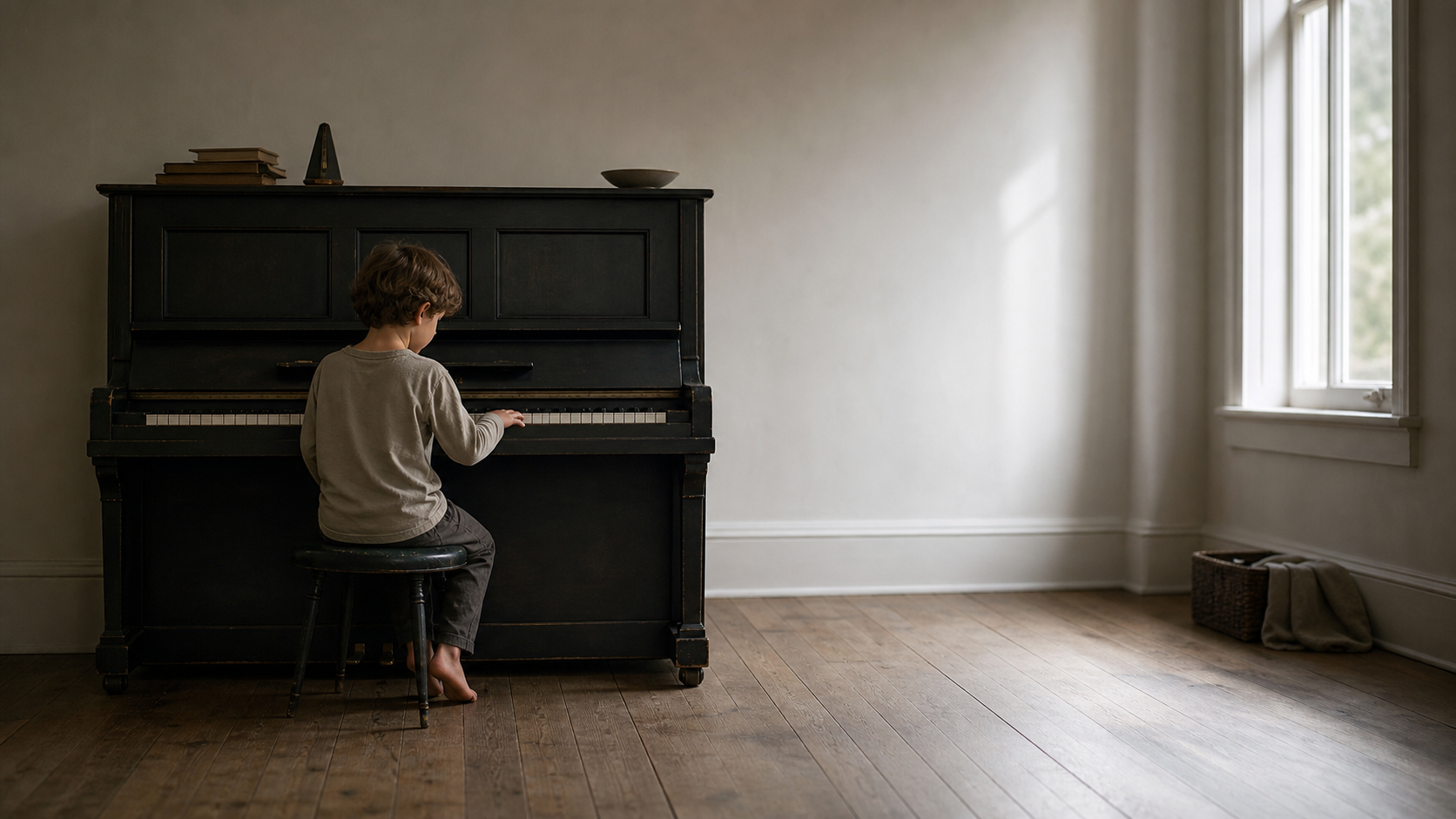
No applause. No teacher. No grade. No parent waiting outside the door.
Would you still sit down at the piano?
We like to believe the purest motivation comes from within: the pianist plays for music, the student for knowledge, the athlete for the joy of the game. Money, praise, trophies, and grades belong to a cheaper motivational economy.
But where did that inner love come from? And how much of the audience disappears when the room becomes empty?
The Definition Works—Until Real Life Begins
Psychology draws the line cleanly. Intrinsic motivation means doing an activity for its inherent interest or enjoyment. Extrinsic motivation means doing it for a separable result: a prize, grade, approval, status, or avoided punishment.
The distinction locates the payoff. Solving a puzzle can be satisfying in itself; solving it for ten dollars attaches a separable reward. But human motives also have histories.
A pianist may genuinely love the feeling of bringing a musical passage to life. She may also have spent childhood seeing adults delighted by her playing. A student may love learning and being known as intelligent. An athlete may enjoy movement, teammates, recognition, and the identity of being disciplined. A writer may work privately while imagining a future reader.
What is intrinsic, and what began outside?
Put a Piano in an Empty Room
Imagine a normally socialized child entering a room alone. The child has never seen or heard a piano and has never been told that musical ability is admirable. There is no teacher, audience, competition, prize, or expectation attached to the instrument.
Would the child touch it? Pressing a key produces an immediate and surprising change in the room. Press another and the sound changes. Strike softly, then loudly. Actions can be repeated, compared, predicted, and combined.
That small loop contains several possible rewards before society enters the picture: novelty, sensory pleasure, pattern, agency, relief from boredom, and the growing feeling of mastery. The child makes the room answer back.
Could that be enough to hold the child’s attention for an afternoon? Very possibly. Long enough to become a virtuoso? That is harder to believe. Virtuosity requires sustained difficulty, cultural techniques, models of what is possible, and reasons to tolerate long stretches when practice is not enjoyable.
The thought experiment therefore separates two questions we often collapse. What makes someone begin exploring? And what makes someone build a life around the exploration?
The Strongest Case for Something Truly Intrinsic
Humans do not arrive as empty containers waiting for a gold star. Children play, test, climb, imitate, and investigate before anyone explains the exchange rate between effort and approval.
Robert White argued in 1959 that theories based only on drives and deficit reduction left something important out. Organisms also appear motivated to interact effectively with their environment—to develop competence. Contemporary self-determination theory makes a related claim: people have active tendencies toward learning, mastery, and integration, supported by experiences of autonomy, competence, and relatedness.
The piano encounter gives this argument a clean stage. No social reward is required for a sound to be interesting, a pattern to become satisfying, or increased control to feel good. Curiosity does not need a certificate before it can operate.
Pure intrinsic motivation, then, is not an absurd idea. It may be one of the basic mechanisms through which a flexible organism learns about its environment.
The Audience Moves Inside
Now imagine what happens after that first encounter.
A parent smiles at the first tune. A teacher says, “You have real talent.” Other students notice. Practice signals discipline; performance brings status. Eventually the standards no longer require an adult in the room.
This is what I mean by the internal audience. It is not a formal diagnosis or a tiny crowd literally living in the mind. It describes how parents, teachers, peers, imagined readers, and cultural ideals can continue to watch after they have left. Sometimes it applauds: I am creative. I am intelligent. I am the kind of person who finishes. Sometimes it threatens: If I stop, what does that say about me?
Self-determination theory describes part of this process. Behavior can begin under external regulation—rewards and punishment—then become partially internalized as pride, guilt, shame, or contingent self-worth, a form called introjection. With identified regulation, a person consciously endorses the activity’s value. With integrated regulation, that value becomes congruent with a broader identity.
Identification and integration can feel deeply chosen while remaining extrinsic if the activity still serves a separable purpose. I may run because health matters to me even when running itself is miserable. That is autonomous extrinsic motivation: meaningful and self-endorsed, but not necessarily intrinsic. The boundary is less like two boxes than a migration.
Rewards Do Not All Say the Same Thing
This matters in classrooms because teachers constantly shape the story students tell themselves about why they are working.
The classic warning comes from Mark Lepper, David Greene, and Richard Nisbett’s 1973 study. Preschool children who already enjoyed drawing with special markers were placed in different conditions. Children promised an award beforehand later showed less interest during free play than children who received no award or an unexpected one. The proposed overjustification effect is unsettling: add a conspicuous external reason to an activity someone already enjoys, and the person may reinterpret the activity as something done for the reward.
A 1999 meta-analysis by Edward Deci, Richard Koestner, and Richard Ryan examined 128 experiments and found that several expected tangible reward arrangements reduced later free-choice engagement. It also found that positive feedback could enhance interest. That difference is crucial.
A sticker can communicate, “Do this because I am controlling the payoff.” Feedback can communicate, “You are becoming more capable.” The physical reward is not the only variable. The meaning of the exchange matters.
The research debate is not completely settled. Judy Cameron, Katherine Banko, and W. David Pierce reanalyzed the literature and argued that negative effects were limited rather than pervasive. Their 2001 meta-analysis found benefits for low-interest tasks and positive effects from verbal rewards, while identifying the riskiest pattern as an expected, tangible reward offered for a high-interest activity and only loosely connected to performance.
So “never reward children” is not a serious conclusion.
If a child already disappears happily into drawing, paying per picture may replace a rich reason with a thin one. If a difficult or initially unappealing task rarely begins at all, a modest incentive may help start the engine. The educational question is what happens next. Does the reward provide a bridge toward competence and ownership, or does it become the only reason to cross?
Before offering a reward, ask: Is there already an interest here to weaken? Does the reward feel controlling or informative? What will make the activity worth continuing when the reward disappears?
Grades create the same problem at scale. They can carry useful information, open real opportunities, and help students orient themselves. They can also train students to stop asking, “What is interesting here?” and start asking, “Is this on the test?” Praise can recognize genuine growth, or it can make approval the product.
The practical goal is not to remove every external influence. That would be impossible. It is to help students experience choice, understand why difficult work matters, notice increasing competence, and gradually take ownership of standards that once belonged to the teacher.
Biology Is Also Paying Us
In psychology, intrinsic does not mean “uncaused.” It means that the immediate satisfaction lies in doing the activity rather than in a separable outcome. From a philosophical distance, however, curiosity, pleasure, play, and mastery are also reward systems. Evolution built nervous systems that make certain kinds of exploration worth continuing.
The child presses the piano key without social approval, but not without a causal history. Biology supplied the reward system before society supplied the audience.
That does not make curiosity extrinsic unless we stretch the term until it stops being useful. The child experiences exploration as rewarding in itself; at the psychological level, that is precisely what intrinsic motivation means. Calling a motive intrinsic locates the reward. It does not finally explain why that reward exists.
Most Motivation Is Hybrid
The pianist can love music and recognition. The athlete can love the game and the team identity. The student can enjoy discovery and being seen as intelligent. The writer can be absorbed by a sentence while imagining the reader. These motives overlap, reinforce one another, compete, and change with time.
An external invitation can open the door to genuine fascination; fascination can later become entangled with status. The more useful question may not be, “Is my motivation intrinsic or extrinsic?” but, “What combination is operating now—and which part do I want to strengthen?”
References
Ryan, R. M., & Deci, E. L. (2020). Intrinsic and extrinsic motivation from a self-determination theory perspective: Definitions, theory, practices, and future directions. Contemporary Educational Psychology, 61, 101860.
White, R. W. (1959). Motivation reconsidered: The concept of competence. Psychological Review, 66(5), 297–333.
Lepper, M. R., Greene, D., & Nisbett, R. E. (1973). Undermining children’s intrinsic interest with extrinsic reward: A test of the “overjustification” hypothesis. Journal of Personality and Social Psychology, 28(1), 129–137.
Deci, E. L., Koestner, R., & Ryan, R. M. (1999). A meta-analytic review of experiments examining the effects of extrinsic rewards on intrinsic motivation. Psychological Bulletin, 125(6), 627–668.
Cameron, J., Banko, K. M., & Pierce, W. D. (2001). Pervasive negative effects of rewards on intrinsic motivation: The myth continues. The Behavior Analyst, 24(1), 1–44.
TL;DR
Pure intrinsic motivation probably exists: curiosity, play, sensory pleasure, agency, and mastery can reward an activity without praise or prizes. But most adult passion is hybrid, shaped by biology, social experience, identity, and external incentives. Rewards can undermine an existing interest when they feel controlling, but informational feedback and carefully used incentives can also support competence or help difficult behavior begin.
Perhaps intrinsic motivation is real—but much of what we call passion is external reward that has learned to speak in our own voice.
If every real and imagined observer fell silent, what would you still choose to play?