
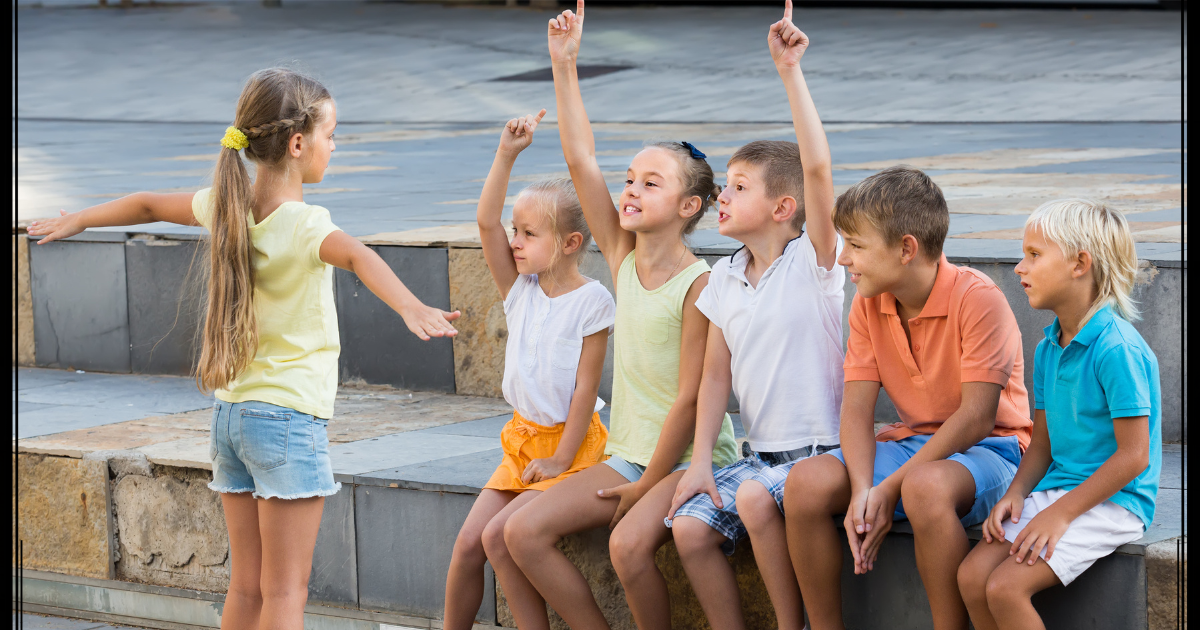
Charades has a strange reputation in language classrooms. Students love it. Teachers sometimes feel a little guilty about it. It looks like a break from real learning—and yet it consistently produces some of the most engaged language use you’ll see in class.
That’s not an accident. Charades works because it aligns closely with how humans actually learn language: through action, interaction, and meaning—not translation.
Why Charades Is More Than a Game
When students play charades, they interpret meaning, connect language to movement, and retrieve vocabulary under mild time pressure. Those conditions resemble real communication far more than worksheets or drills.
This fits with research on embodied cognition, which shows that learning grounded in physical action leads to stronger memory than abstract input alone (Barsalou, 2008).
Why It Works at Any Level
Beginners benefit because charades lowers speaking pressure. Guessing with single words or gestures still counts as meaningful participation, supporting a low affective filter (Krashen, 1982).
Intermediate learners are pushed toward clearer distinctions and fuller expressions, while advanced learners refine meaning, explain processes, and negotiate interpretation.
The task stays the same. The language grows.
Why Students Remember Charades Vocabulary
Charades benefits from several well-established learning effects: the enactment effect (Engelkamp & Zimmer, 1984), the generation effect (Slamecka & Graf, 1978), and multimodal encoding (Paivio, 1991).
This is similar to why techniques like shadowing are so effective—-it all comes down to active participation, which bolters our memory
Making Charades Work in Real Classrooms
Charades only falls apart when it’s under-structured. Clear categories, controlled difficulty, and quick pacing make the difference between chaos and learning.
That’s why I built Pera Pera Charades with three categories—animals, objects, and actions—each with three levels of difficulty.
It is to remove unnecessary friction so teachers can focus on judgment rather than logistics.
Final Thought
If students are moving, laughing, guessing, and negotiating meaning, they’re doing real language work—even if it doesn’t look traditional.
Charades works because it aligns with how humans learn: through action, interaction, and shared attention.
References
Barsalou, L. W. (2008). Grounded cognition. Annual Review of Psychology, 59, 617–645.
Engelkamp, J., & Zimmer, H. D. (1984). Motor programs and semantic memory. German Journal of Psychology, 8.
Krashen, S. D. (1982). Principles and practice in second language acquisition.
Paivio, A. (1991). Dual coding theory. Canadian Journal of Psychology, 45(3).
Slamecka, N. J., & Graf, P. (1978). The generation effect. Journal of Experimental Psychology.