
A polished paragraph is not the goal. A learner who can say what they mean is.
AI makes that distinction impossible to ignore. For a long time, we could treat student writing as evidence of student thinking because the writing itself took real effort to produce. Now a student can ask a machine for a clean draft in seconds. If the assignment only asks for polished text, the assignment has lost a lot of its instructional power.
That does not make writing less important. It makes the purpose of writing more important. In second language education, writing should not be the final destination. It should be a tool students use to prepare themselves for communication.
Writing should make speaking better.
And speaking should send students back to writing with a clearer sense of what they actually want to say.
The Notebook Moment
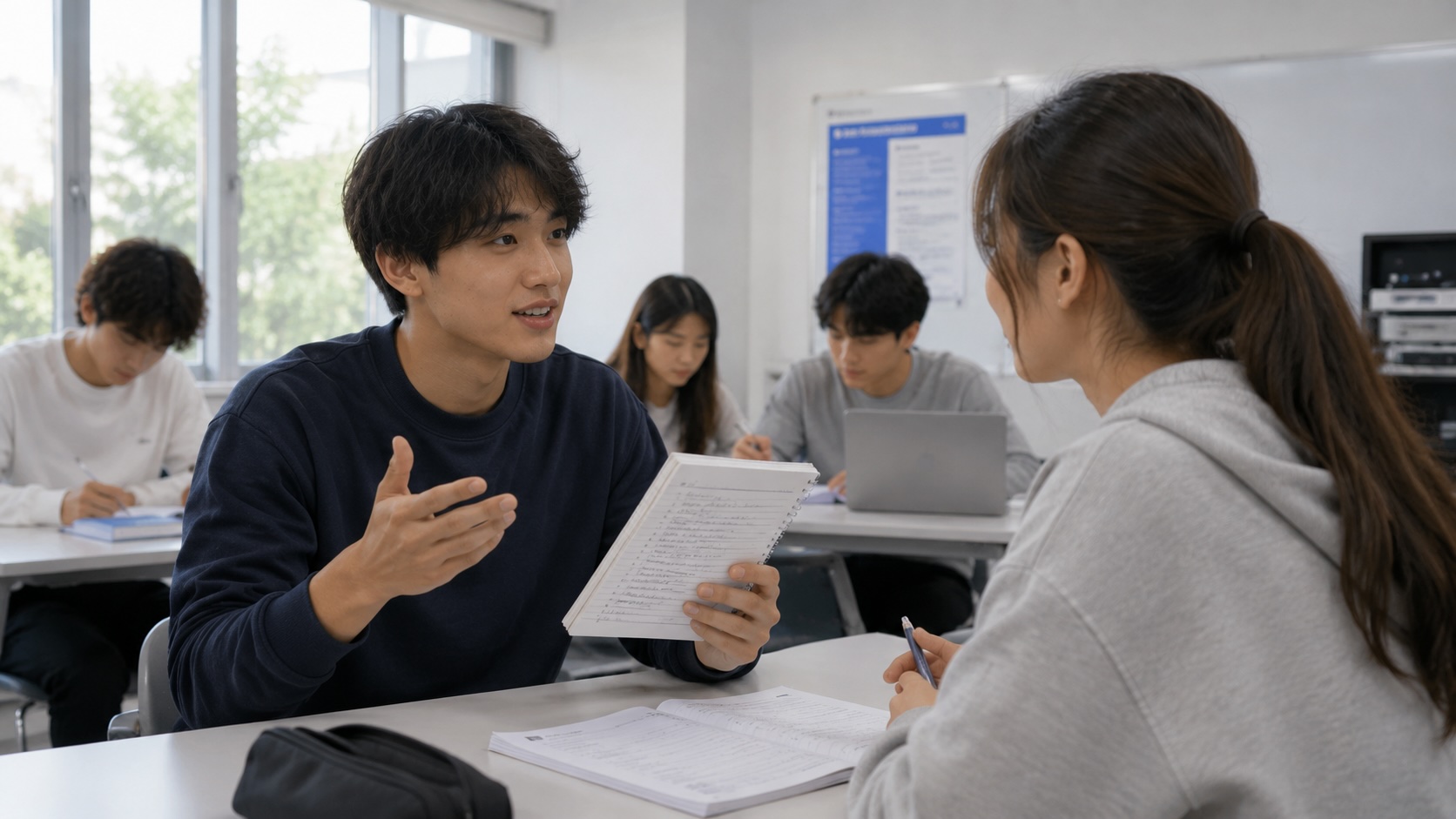
The best writing moments in a language classroom often do not look like writing moments. A student has a notebook open. There are crossed-out phrases, half-sentences, arrows, maybe a translation they are not sure about. Then the student looks up and tries to say the idea to a partner.
That is the moment I care about. The notebook is not the product. The notebook is the launchpad.
When students write before speaking, they get time that speaking does not usually give them. They can slow down, choose words, test grammar, notice missing vocabulary, and organize the shape of an idea before real-time pressure hits. Writing gives them a private rehearsal space. Speaking makes the rehearsal matter.
Make the Draft Talk
My rule is simple: if students write something in a language class, that writing should probably be used for speaking at least once.
A paragraph can become a short explanation. A journal entry can become a pair discussion. A list of opinions can become a small-group debate. A written reflection can become a one-minute recorded response. The point is not to turn every writing task into a presentation. The point is to stop letting writing die on the page.
Speaking also reveals things that silent writing hides. A sentence that looks fine on paper may be impossible for the student to say smoothly. An idea that seemed complete may fall apart when a partner asks one follow-up question. A word choice that looked academic may sound unnatural in conversation. That is useful information.
A better loop: talk first, draft, speak from the draft, revise, and speak again. The draft improves the speaking. The speaking improves the draft.
AI Changes the Bargain
AI is very good at producing text that looks finished. That is exactly why it is dangerous to treat finished-looking text as the main goal.
But AI can be useful if we put it in the right place. It can help students compare phrases, find missing vocabulary, simplify an overcomplicated sentence, or get feedback before they speak. It can act like a preparation partner. What it should not do is replace the moment where the student has to own the idea in their own voice.
If a student uses AI to draft a better answer and then uses that answer to speak more clearly, ask better questions, and revise more honestly, I am not worried. If the AI draft is where the task ends, I am worried.
Full AI Drafts Are Not Automatically the Enemy
I am also not convinced we need to draw the line at "AI can help, but it cannot write the whole thing." In real classrooms, some students will use AI to complete assignments. Some will do it carefully. Some will do it lazily. Some will call it support. Some teachers will call it cheating. That argument will not disappear.
But if the writing begins with the student's ideas, I am comfortable with AI doing a lot of the sentence-level work. A student might brainstorm their own opinion, examples, and reasons, then ask AI to turn those ideas into a full paragraph or essay. That is not the same as outsourcing the entire act of thinking. It is closer to using AI as a language engine.
The important move is what happens next. If the AI-written essay becomes a speaking task, the question of whether the student "cheated" matters less. The student still has to read the text, understand the ideas, select useful language, and speak from it. At minimum, they are getting input through reading and output through speaking. That is already better than a polished essay submitted silently and forgotten.
We can also make the AI draft into material for language study. Students can break apart a fully written AI essay and practice the vocabulary, sentence frames, transitions, and grammar structures inside it. They can underline phrases they want to steal for future speaking. They can rewrite one paragraph in simpler language. They can turn three sentences into speaking prompts. The draft becomes a quarry, not a trophy.
What I Would Assess
I would care less about whether the first draft is perfect and more about whether the student can do something with it.
- Can the student use the draft to explain an idea to another person?
- Can they answer a follow-up question without collapsing?
- Can they revise the draft after speaking?
- Can they identify which language helped them communicate and which language got in the way?
- Can they break apart an AI-written draft and reuse its vocabulary or sentence structures in speech?
Those are not side activities. They are the real evidence of learning.
TL;DR
AI should push us to stop treating writing as an isolated school product. Even full AI-written drafts can be useful if they start from student ideas and are turned into reading, speaking, vocabulary, sentence-structure, and revision work. The future is not less writing. It is writing with a job to do.